Claude on Azure: The Marketplace Billing Trap
Why Microsoft for Startups credits do not cover Claude on Azure Foundry, where Claude Opus 4.7 actually deploys, and the pre-flight checks architects must run before shipping.

In March 2026, Tominaga Takuya, founder and CEO of Tokyo-based startup Leach, published a cautionary tale. He had Microsoft for Startups Founders Hub credits. He deployed Claude Opus on Azure AI Foundry. He shipped a feature. The first invoice was ¥237,081 (about $1,600 USD), charged directly to his credit card. The startup credits had not covered a single Claude token.
He was not alone. A second Japanese founder racked up over ¥2,000,000 (about $13,000) in Claude charges in one month. German founder Bogdan Sevriukov hit €999.60. Riyaj Shaikh, a third founder, reported being billed several thousand dollars in a follow-up case. The Register also reported evidence of an approximately $3,000 charge against another startup whose credits stayed unused. A separate Microsoft Q&A thread opened by Nitika Garg on March 10, 2026 reports the same pattern on a Microsoft Azure Sponsorship account; in the comments, Spanish founder Iván de Blas (April 9, 2026) describes a €2,419.92 charge that landed on his credit card while the Azure billing portal showed €0.00. The largest case made public so far is a Microsoft Tech Community post by chrisbaker2000 on April 13, 2026: two consecutive invoices of $1,078.07 and $16,414.94 totalling $17,493.01, with the second invoice accumulating during the half of the month after the founder had already removed all Anthropic deployments.
Tominaga then drafted a Change.org petition demanding clearer warnings, visual differentiation between native and Marketplace models, refunds for affected founders, and a public acknowledgement. It launched March 11, 2026, and as of May 5, 2026 had collected 50 signatures. Within days of launch, The Register and InfoWorld covered the story. The petition itself notes a formal complaint was filed with Japan’s Fair Trade Commission.
Sevriukov opened a Microsoft Q&A thread on January 20, 2026 reporting his charge. The thread was later locked by Microsoft. The page now displays the literal banner “Locked Question. You can vote on whether it’s helpful, but you can’t add comments or replies.” Microsoft moderator Manas Mohanty did acknowledge the issue there on Feb 27 and Mar 6, 2026 before the thread was locked. A separate Q&A thread asking the eligibility question directly confirms the answer: Claude on Foundry is not covered by Founders Hub credits.
Microsoft’s official statement to The Register: “We listen closely to customer feedback and are continuously working to provide clear guidance in our product documentation, including pricing details and credit eligibility.” Anthropic’s position, communicated to affected founders: it has no visibility into Azure billing and cannot process refunds independently.
This is not a UI bug. It is the Marketplace billing model working as designed, and it is the single most important thing to understand before you deploy any third-party model on Azure, including Claude, Llama, Mistral, Cohere, or anything else that did not originate inside Microsoft.
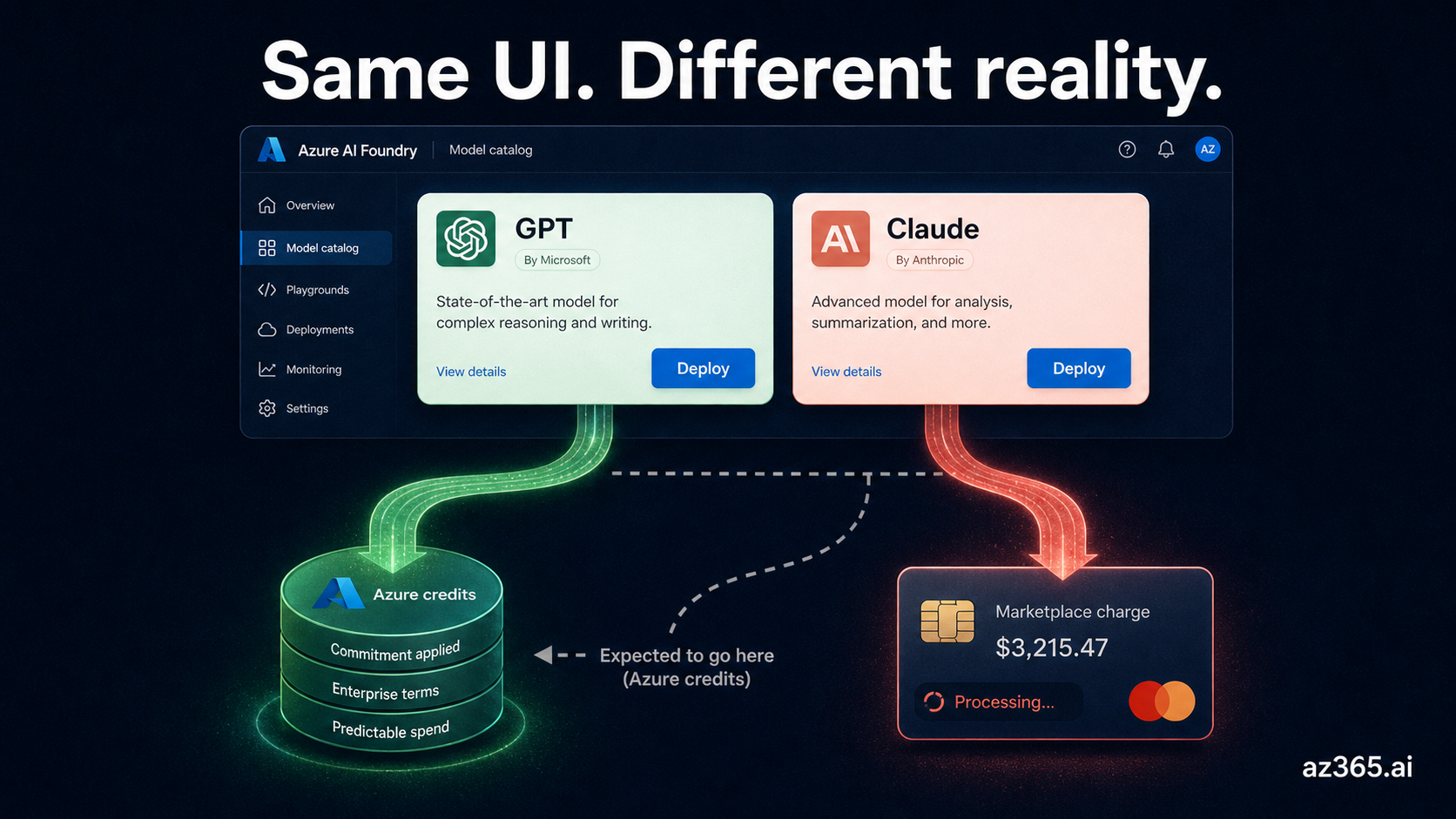
What Actually Happened to the Founders
Three founders, three subscription types, three different invoice sizes. Same root cause.
Tominaga enrolled in Microsoft for Startups Founders Hub and received Azure credits through the program (which offers up to $150,000 in credits at the top tier). He used Foundry to deploy Claude Opus. From the Foundry catalog UI, Claude appeared next to GPT-5 and Phi with the same “Deploy” button, the same Endpoint and Key ceremony, the same dashboard. Behind the scenes, two completely different billing pipelines were running: GPT through Azure first-party billing where Founders Hub credits applied, and Claude through Azure Marketplace where they did not. He did not know this until the invoice arrived. His direct quote, captured in The Register’s coverage:
The UI makes no distinction between credit-covered and Marketplace-billed models.
This trap is documented openly in Microsoft’s own subscription rules but easy to miss. From the official Foundry Claude deployment documentation:
If you have an account with a credit card on file, the credit card will be charged instead of Azure Credits.
So even on a sponsored subscription with substantial unspent credits, the credit card on file gets charged the moment a Marketplace product runs. The credits sit untouched.
Founders report a support loop that became its own story. Across The Register’s coverage, the Microsoft Q&A threads, and the Microsoft Tech Community post, the same description recurs: Microsoft support directed them to Anthropic; Anthropic, which says it has no visibility into Azure billing, directed them back to Microsoft. Microsoft’s official statement is that it is “continuously working to provide clear guidance” on credit eligibility, but the named founders’ invoices stood at the time of writing.
This is not a one-off UX bug. It is the fundamental architecture of how Azure resells third-party AI on its cloud. Microsoft has acknowledged the documentation gap and stated it is improving guidance, but the underlying Marketplace billing model itself is unlikely to change.
Why Founders Hub Credits Do Not Cover Claude
Microsoft’s credit balance documentation is direct on this point:
Azure credits don’t apply to certain products and services. Any usage of these offerings is billed separately and charged regardless of your available Azure credit balance. In general, Azure credits don’t cover: Partner-provided products or services, along with non-Microsoft products on Microsoft Marketplace.
The Azure for Startups credit terms are even more explicit:
Startup credits cannot be used for Microsoft Azure support plans, third-party branded products, products sold through Microsoft Azure Marketplace, or products otherwise sold separately from Microsoft Azure.
And separately, the Foundry Claude deployment requirements list four unsupported subscription types:
- Enterprise Accounts located in South Korea
- Cloud Solution Provider subscriptions
- Azure subscriptions that don’t have an active pay-as-you-go billing method (for example, student, free trial, or startup credit-based accounts)
- Sponsored subscriptions that only use Azure credits.
Three of those four exclusions hit Claude directly. Claude is third-party branded (it is an Anthropic product). It is sold through Azure Marketplace. Sponsored credit-only subscriptions are explicitly excluded. So Founders Hub credits cannot cover Claude usage by three independent rules at once.
This is not a Claude-specific issue. The same applies to:
- Llama models from Meta
- Mistral models on the Mistral Marketplace listing
- Cohere models
- Stability AI image models
- Any other Models-as-a-Service offering that ships with a partner brand
If you are running on credits, the only AI models you can use without surprise charges are first-party Microsoft services: Azure OpenAI (GPT family, o-series), Phi from Microsoft Research, and other Microsoft-published models in Foundry. Everything else is Marketplace, regardless of how seamless the deployment UI feels.
The 1P vs 3P Decision Tree on Foundry
Foundry’s model catalog mixes first-party (1P) and third-party (3P) models in the same UI without much warning. The architectural decision tree before picking a model:
| Question | 1P (Azure OpenAI, Phi) | 3P / Marketplace (Claude, Llama, Mistral) |
|---|---|---|
| Billing pipeline | Azure first-party billing | Azure Marketplace |
| Founders Hub / startup credits cover it | Yes | No |
| Sponsored / MSDN / Visual Studio credits cover it | Yes | No |
| Free trial credits cover it | Yes (subject to limits) | No |
| Enterprise Agreement (EA) coverage | Yes (any geo) | Yes, EXCEPT EA accounts in South Korea |
| MCA-E coverage | Yes | Yes |
| CSP subscription support | Yes | Not supported |
| Pay-as-you-go subscription | Yes, no friction | Not currently - quota is zero by default |
| Default quota for new subscriptions | Usually allocated for OpenAI | Zero RPM, zero TPM until ticketed |
| Sponsored sub with credit card on file | Credits used first | Credit card charged immediately |
| Available regions | Many, varies by model | East US 2 and Sweden Central for Claude |
| Procurement category | Azure spend (cloud committed spend) | Marketplace spend (separate budget line) |
The last row catches most enterprises. In a large company, “Azure spend” and “Azure Marketplace spend” are tracked separately, may sit in different budgets, are governed by different procurement teams, and have different approval thresholds. A team with full Azure budget authority may have zero authority to approve Marketplace purchases. The UI does not enforce the distinction. Finance does.
Where Claude Actually Deploys
As of April 2026, Microsoft Foundry supports a substantial Claude lineup. From Microsoft’s own deployment documentation:
| Model | Status | Context window | Notes |
|---|---|---|---|
| claude-opus-4-7 | Preview (released April 16, 2026) | 1M tokens, 128K max output | Most capable Opus, adaptive thinking only |
| claude-opus-4-6 | Preview | 1M tokens, 128K max output | Production-stable Opus generation |
| claude-opus-4-5 | Preview | 200K tokens, 64K max output | Older Opus, smaller context |
| claude-opus-4-1 | Preview | 200K tokens | Legacy, prefer 4.6 or 4.7 |
| claude-sonnet-4-6 | Preview | 1M tokens, 128K max output | Frontier intelligence at scale, 1M GA |
| claude-sonnet-4-5 | Preview | 200K standard | 1M context beta retires April 30, 2026, migrate to 4.6 |
| claude-haiku-4-5 | Preview | 200K tokens | Speed and cost optimization |
| claude-mythos-preview | Gated research preview | 1M tokens, 128K max output | Cybersecurity, autonomous coding, long-running agents |
All Claude models on Foundry are deployment-type “Global Standard” only. There is no PTU, no provisioned throughput, no DataZone yet (US DataZone is on the roadmap). Two regions support deployment, period:
- East US 2 (the primary region, most stable)
- Sweden Central (added later, currently flakier in practice)
If your data residency requirements pin you to West Europe, UK South, Australia East, Germany West Central, or any other region, Claude on Azure is not an option. You either deploy via the Anthropic API directly (different data flow, different DPA), via AWS Bedrock (broader region coverage), or pick a different model.
There is one more wrinkle. Anthropic enforces its own “Supported Regions Policy” on top of Azure’s regional deployment. Even if your Azure tenant is in a supported deployment region, Anthropic may block the model based on the geography of the user invoking it. Verify both layers.
The Sweden Central availability also comes with an active failure mode. Multiple practitioners report deployment failing with this error on Claude Sonnet 4.6 and Claude Opus 4.6:
{
  "status": "Failed",
  "error": {
    "code": "ResourceOperationFailure",
    "message": "The resource operation completed with terminal provisioning state 'Failed'.",
    "details": [{
      "code": "AnthropicOrganizationCreationFailed",
      "message": "Internal Server Error."
    }]
  }
}
Microsoft Q&A threads tracking this failure have remained open without a published root cause. The only known workaround is to retry the deployment in East US 2 instead. If you are designing architecture today, treat Sweden Central as best-effort and assume East US 2 is your real production region. Plan data residency and latency math accordingly.
Default Quota Is Zero. Yes, Zero.
This is the second pitfall, and it costs more days of engineering time than the billing surprise costs dollars.
Even on a fully eligible Enterprise Agreement subscription, in East US 2, with the Microsoft.CognitiveServices provider registered and the right RBAC, the default Claude quota is zero. Zero RPM. Zero TPM. From the Microsoft Foundry quota table:
| Model | Default RPM | Default TPM | Enterprise + MCA-E RPM | Enterprise + MCA-E TPM |
|---|---|---|---|---|
| claude-opus-4-7 | 0 | 0 | 2,000 | 2,000,000 |
| claude-opus-4-6 | 0 | 0 | 2,000 | 2,000,000 |
| claude-sonnet-4-6 | 0 | 0 | 2,000 | 2,000,000 |
| claude-haiku-4-5 | 0 | 0 | 4,000 | 4,000,000 |
The “Default” column is what you get from Microsoft Foundry the moment the subscription becomes eligible. Nothing. The “Enterprise and MCA-E” column is what you get after a manual quota request through the quota increase request form is approved. This means every Claude project on Azure starts with a support ticket as a hard prerequisite, not as an escalation step.
The design intent is confirmed in Microsoft Q&A responses: Claude models are Marketplace-based offerings, so quota is not auto-assigned to every subscription. Even on subscriptions with valid billing and accepted Marketplace terms, the quota can show 0/0 until backend enablement is processed by Microsoft engineering.
The blast radius of this is bigger than it looks. If your dev tenant has Claude working and your prod tenant does not, your CI/CD pipeline will fail silently in production with what looks like a permissions issue. The error message gives no hint that the actual problem is “your prod subscription has not been backend-enabled by a Microsoft engineer yet.”
Plan to file the quota request as the first action, on day one of the project, before any code is written.
Real Cost Math: Claude Opus 4.7 vs GPT on Azure 1P
Claude Opus 4.7 is the current production-aimed Anthropic model on Foundry, released April 16, 2026. Pricing per million tokens:
- Input: $5 per million
- Output: $25 per million
- Cache reads: roughly 10% of input rate (about 90% savings)
- Cache writes: roughly 25% premium over input
- Batch: 50% discount on async workloads
The headline rates are unchanged from Opus 4.6, but the real cost is not, because Opus 4.7 ships with a new tokenizer that can produce up to 35% more tokens for the same input text. The multiplier is 1.0x to 1.35x in practice, with the higher end most often on code, structured data, and non-English text. So a request that cost $0.10 on Opus 4.6 can cost $0.10 to $0.135 on Opus 4.7 for identical work. A team running ~$10/day on 4.6 should expect ~$10 to $13.50/day on 4.7. Across a year that is up to a $1,200 swing on a small workload, before factoring scale-out.
Compare to GPT family on Azure 1P (first-party):
| Use case (rough) | Claude Opus 4.7 on Azure (Marketplace) | GPT family on Azure OpenAI (1P) |
|---|---|---|
| 10K req/day, 8K input, 1K output | ~$190/day on Opus 4.7 (after tokenizer multiplier) | Substantially cheaper, varies by GPT tier |
| Founders Hub / startup credits cover it | No | Yes |
| Subscription required | EA or MCA-E + non-South-Korea + zero-quota ticket | Most subs work, no ticket |
| Tokenizer surprise | Up to 35% more tokens vs the same content on 4.6 | Stable across versions |
| Available regions | East US 2, Sweden Central | Many |
| Reasoning quality on hard tasks | Strongest available 4.x family for long-context coding and agentic work | Strong; Opus 4.7 typically wins on long-context and multi-hour agent runs |
The math says: pick Claude Opus 4.7 when its reasoning ceiling and 1M context actually win for the workload, and you have a paid budget that can absorb both Marketplace billing and the tokenizer multiplier. Pick GPT on Azure 1P when good-enough reasoning meets the bar, you want credits to apply, and you do not need 1M context. There is no neutral default.
For high-volume classification or routing, Claude Sonnet 4.6 ($3/$15 per million tokens) or Haiku 4.5 is usually the right call. Sonnet 4.6 has 1M context generally available. Sonnet 4.5’s 1M-context beta retires April 30, 2026, so any code still using the context-1m-2025-08-07 beta header on Sonnet 4.5 must migrate before then.
The Pre-Flight Checklist Before You Deploy Claude
Most of this article’s pain is avoidable with a 30-minute pre-flight check. Run it before you commit any project to Claude on Azure.
- Confirm subscription eligibility. Run
az account show. Verify the subscription is EA (and NOT a Korean EA) or MCA-E with a billing method. CSP, sponsored, free-trial, MSDN, and credit-only subscriptions cannot deploy Claude. - Confirm credit applicability. If you are on Founders Hub, MSDN, sponsorship, or any credit pool, assume credits do NOT apply to Claude. If a credit card sits on the same subscription, that card is charged the moment Claude runs. Either commit to paid spend or pick a 1P model.
- Pick a region. East US 2 if at all possible. Sweden Central only if data residency demands it, with a documented fallback for the AnthropicOrganizationCreationFailed error.
- File the quota ticket BEFORE writing code. Default quota is zero. Request the Enterprise/MCA-E allocation for the specific Anthropic models on the specific subscription. Day one, not when CI/CD is failing.
- Set up Azure Monitor budget alerts on Marketplace category specifically. Marketplace charges roll up under a separate billing dimension. Filter on
MeterCategorycontaining the Anthropic publisher, not just total Azure spend. - Document the procurement category to finance. Tell finance that AI workload spend will land partly in Azure billing and partly in Marketplace billing. Confirm the budget structure supports both.
- Decide the fallback model. If Anthropic gets pulled, your subscription gets reclassified, or pricing shifts, what is your path? GPT-5 on Azure 1P? Claude direct via Anthropic API? AWS Bedrock? Have an answer documented before you start.
- Plan for the 35% tokenizer multiplier. If you are migrating from Opus 4.6 to 4.7, expect costs up to 35% higher for the same inputs. Decide whether the quality gain justifies it or whether 4.6 is the better cost ceiling for your use case.
Should You Deploy Claude on Azure At All?
This is the architecture question hiding under the cost question. There are three real choices for running Claude in production right now:
Option A: Claude on Azure AI Foundry (Marketplace). Wins when Microsoft is your dominant procurement vehicle, you need Foundry orchestration, you want Claude to sit alongside GPT-5 behind the same APIM gateway, and you have EA or MCA-E billing in a supported geography. Loses on credits, regions, CSP support, and the zero-default quota ceremony.
Option B: Claude direct via Anthropic API. Wins on speed (instant access, no quota tickets), region flexibility (Anthropic has more regions than Azure does for Claude), latest model availability (Anthropic ships new Claude versions to their direct API first by days to weeks), and credits if you negotiate Anthropic startup credits separately. Loses on Microsoft procurement consolidation, Foundry-native tracing, and any compliance posture that requires “everything goes through Azure.”
Option C: Claude via AWS Bedrock or GCP Vertex. Wins for shops already on AWS or GCP, where Claude integrates with the cloud-native observability stack and Marketplace billing is a single bill from a single vendor. Loses on Microsoft integration entirely, but for organizations where Microsoft is not the primary cloud, this is often the cleanest path.
The honest answer is that most enterprises end up with Option A for production and Option B for development. Architects who pretend “Azure has Claude now, problem solved” without understanding the Marketplace mechanics will hit the same trap thirty-five founders documented in the petition.
What This Tells You About Multi-Provider AI Architecture
Take a step back. Why does this billing model exist?
Because Azure is not a model factory. Azure is a procurement and compute layer that resells AI models from many parties, including Anthropic, Meta, Mistral, Cohere, Stability, and its own OpenAI partnership. The Marketplace billing model exists because each of those vendors has its own DPA, its own pricing, its own region availability, its own quota system, and its own subscription rules. Microsoft cannot absorb all of that into one billing pipeline. They can hide it behind a unified UI, which they do. They cannot make the underlying complexity disappear, no matter how seamless the catalog feels.
For architects, the practical takeaway is provider-neutral by design. The model layer of your AI architecture will always be heterogeneous. Build for that. Use APIM or your own gateway as a routing layer that can shift workloads between Claude (Azure or direct), GPT-5, Llama, and whatever ships next. Treat the question “where does this model run, on what billing pipeline, in what region, with what subscription” as a first-class architecture concern, not a procurement concern that gets handed off.
The founders who got burned were not technically wrong. Their architecture worked. Their procurement assumptions did not match procurement reality. That gap, between architecture and procurement, is exactly where senior AI architects earn their seat at the table.
Related Reading
- Logic Apps as MCP Servers: The Architecture That Actually Works - how to expose Azure resources to AI agents (any provider)
- AI Copilots vs Custom AI on Azure: Build vs Buy - when first-party Microsoft AI wins vs custom on Foundry
- Building AI Solutions on Azure: The Architecture That Actually Works - multi-component AI stack patterns
If you are architecting Claude or other multi-provider AI for a Microsoft business app stack and want a sanity check on the decision matrix above, reach out.
Stay in the loop
Get new posts delivered to your inbox. No spam, unsubscribe anytime.
Related articles
Azure OpenAI PTU vs PAYG: The Real Break-Even Table
Break-even calculators say PTU wins at 150M tokens per month. Real-world utilization breaks that math. Here is the actual table from Microsoft's PTU throughput data, with the utilization curve most architects miss.
The Agent Product Owner Role: The Missing Link Between It Demoed Great and It's Safe in Production
Agents fail on ownership, not model quality. The agent product owner role is the named accountability that makes production deployment defensible on Azure.
AI Agent vs Flow: When Not to Build One (2026 Decision Guide)
When to build an AI agent and when a flow, a query, or nothing is the better tool. A 5-question decision test, worked examples, and the agent tax to budget.